

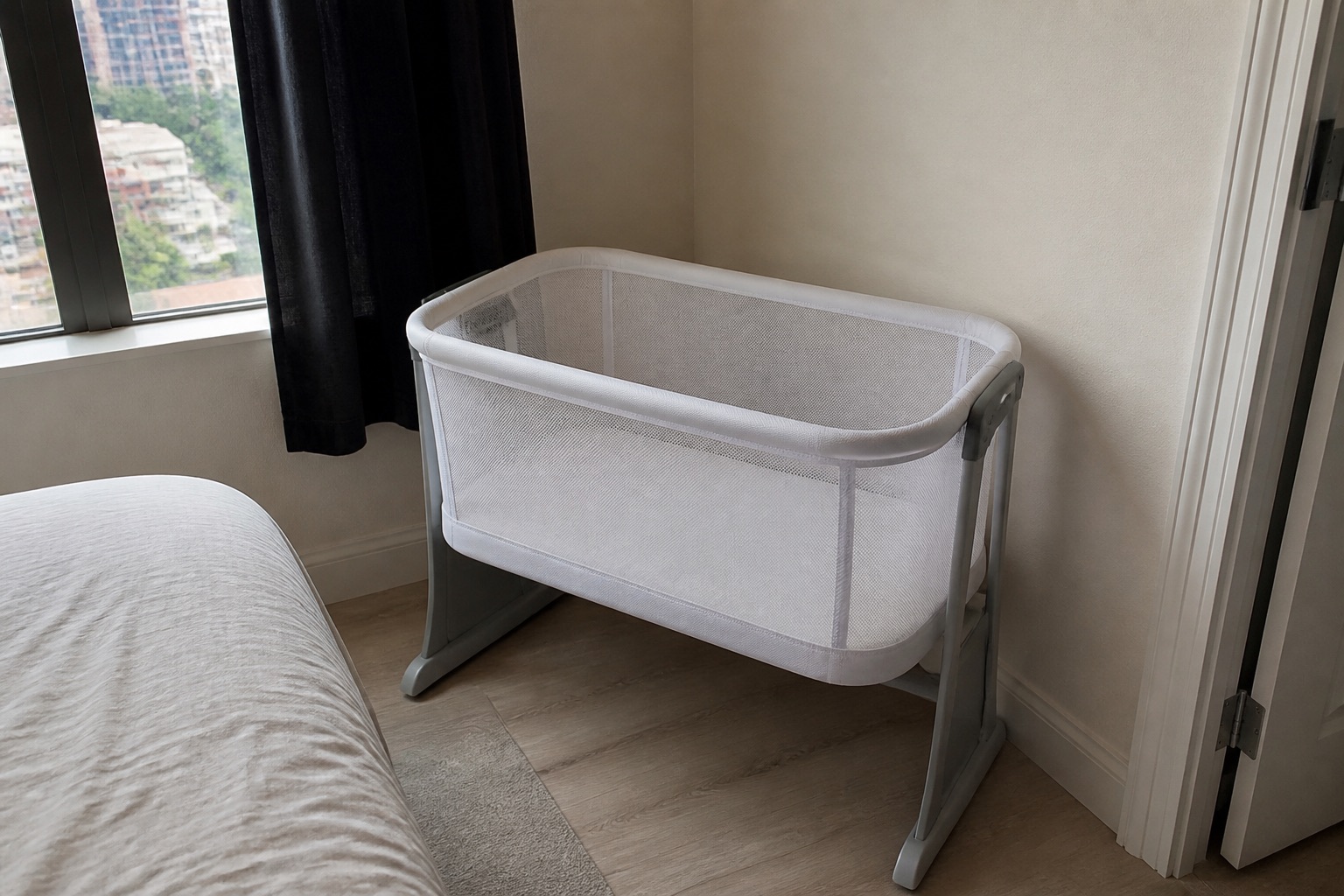
A Florida room fights a baby's sleep three ordinary ways. The air is wet. The air conditioner is loud and cold. Parking-lot lights and a bright sky stay on after you want the room dark. That is true in a Lake Nona apartment, a downtown one-bedroom, and a hotel off International Drive after a park day. The object in the corner, whether it is a bassinet or a play yard, only works if the room around it is set up for those three fights.
The painted duck is the illustration on this page. It is not a crib, not a brand of bassinet, and not a stand-in for a child. No photographs of children appear here. For what belongs inside a sleep space, the U.S. Consumer Product Safety Commission’s Safe Sleep page is the public standard this article cites. This is a nursery guide, not medical advice.
Humidity and the air conditioner
Visit Orlando’s weather page describes a subtropical year: hot, humid summers and milder, drier winters, with plenty of sunshine. NWS Melbourne’s Florida Rain Machine note is more local. Humidity (dew points they describe as 70 degrees or higher) is the switch that turns the rainy season on; when a drier air mass finally arrives, people open windows. In most years that swing is a late-spring to mid-October story. Inside an apartment, it means the air conditioner is not a luxury. It is the room’s weather.
A bassinet next to a vent will blow cold air on a small body. A bassinet in a closed corner with no moving air will sit in a pocket of humidity the rest of the room already shed. Neither extreme is a specification we invent; it is the geometry of a Florida bedroom. Place the sleep space where the room is reasonably even: not in front of the vent, not in a closet of still air, not against a window that sweats. If the unit drips, that is a maintenance issue for the building, not a reason to add a pillow.
Nighttime lows in the warm months often stay in the mid-to-upper 70s outdoors, which is why the machine keeps running. White noise from the compressor is real. Some babies sleep through it. Some do not. A small fan in the room can move air without aiming at the sleep space. Keep cords out of reach. Do not add blankets to "warm up" a baby who is in the vent path. Move the bassinet instead. CPSC's line is still the line: a firm, flat surface and a fitted sheet, baby on the back.
Blackout in a bright city
Orlando does not get dark the way a quiet inland town gets dark. Theme-park sky glow, International Drive signage, pool decks, and east-facing apartment glass all leak light. A park week makes it worse: you return after fireworks or a late exit, the baby is overstimulated, and the hotel drapes were designed for a business traveler who wanted a view of the parking garage.
Blackout is a room job, not a bedding job. Extra blankets in the bassinet are the wrong tool. CPSC says not to add pillows or blankets to a sleep space. Clip the existing drapes. Add a travel blackout piece on the glass. Turn the bathroom light off. Put a low night light where you will walk, not where it shines into the bassinet. A "room light" in our catalog language is that low light. Enough to change a diaper without opening the blackout you just won.
Morning sun in Lake Nona and in many new apartments is fierce. If the only wall for a crib faces east, blackout becomes part of the nursery, not a travel afterthought. Downtown units with streetlights have the same problem at night. Test the room at the hour you actually need it, not at noon.
A bassinet and a play yard are different sleep spaces
CPSC lists products intended for sleep: cribs, bassinets, play yards, and bedside sleepers that meet federal requirements. Those are categories, not shopping links.
A bassinet is a small, dedicated infant sleep space. It sits in a bedroom or a hotel corner. It is for a young baby, for as long as that product’s own manual allows. It is usually the easier object to place next to an adult bed in a tight Orlando apartment. It is not a play space, and it is not a long-term crib.
A play yard is a larger, often folding sleep-and-stay-put space. Hotels in this city commonly lend a play yard when they lend “a crib.” Disney’s own toddlers guide, on the Walt Disney World site, notes that Disney Resorts Collection hotels offer in-room essentials for families upon request, including cribs and play yards. That is their policy to read and confirm; it is not a promise about a random International Drive motel. A play yard travels. It is the usual answer when the room is a hotel and the stay is a week. It is also the usual answer when a Florida apartment is still waiting on a full-size crib, or when grandparents on the other side of town need a legal sleep space that is not a sofa.
Choose from the room you have. A bassinet that will not fit between the hotel dresser and the AC vent is the wrong object. A play yard that takes the entire floor of a downtown studio is the wrong object. In both cases the mattress is the one that came with the product. CPSC is specific: set up a play yard according to the manufacturer, use the mattress pad that came with it, and do not add extra padding. "Bare is Best" means nothing but a fitted sheet.
Inclined products are not sleep spaces in CPSC's writing. Rockers, gliders, soothers, swings with an angle greater than 10 degrees. If a baby falls asleep there, CPSC says to move them to a crib, bassinet, play yard, or bedside sleeper. A car seat is for the car. After a drive down I-4, move the baby.
What CPSC asks of a sleep space
The CPSC Safe Sleep page is short on purpose. Do use products intended for sleep that meet federal requirements. Do place baby on their back. Do keep the space bare except a fitted sheet. Do move a baby who falls asleep elsewhere into that space. Do check recalls at SaferProducts.gov.
Do not add pillows or blankets. Do not use weighted blankets or weighted swaddles, in CPSC’s current don’ts (they point to CDC and NIH for that guidance). Do not leave a baby unsupervised in products that are not designed for sleep.
That list does not change because the room is in Orlando. Humidity is not a reason for a quilt. A hotel “crib bumper,” if one appears, is still a bumper. Take extra fabric out. If you are unsure whether a secondhand crib is legal, CPSC’s crib information is the place to read about assembly, age of the crib, and gaps; this article will not invent a year cutoff beyond what you can verify on that page.
A hotel hold is not a nursery
Family hotels around the parks commonly accept a crib or play-yard request. The common practice, described across hospitality reporting and by the parks’ own hotel pages, is: note it on the reservation, ask again, and confirm at the hotel front desk. Availability is a hotel question. Look at the unit in the room. If it is a play yard, set it up from its own instructions. If it is missing a fitted sheet, that is why a spare sheet is on the hotel-room gear list.
A hotel dresser, a folded extra duvet, and a rollaway bed are not sleep spaces for an infant. Neither is a stroller in the room, even if the baby napped in it at the park. The park day ends when you move the baby to a flat, empty sleep space. Blackout the glass. Set the thermostat so the vent is not a wind tunnel on the bassinet. Put the monitor where you can hear the room if you sit on the balcony. A balcony in this climate is heat and, in summer, a lightning question. NWS Melbourne treats lightning as a primary storm hazard. Come inside.
An apartment in Lake Nona, downtown, or off I-Drive
A first nursery in Orlando is often a second bedroom that still has to hold an adult’s closet, or a studio corner next to the kitchen. The sleep space still has to be flat, empty, and out of the vent. Blackout is part of the furniture budget. A changing surface that is not the adult bed saves the sleep space from becoming a storage shelf. Soft goods here are muslin and fitted sheets, not decorative pillows.
Lake Nona mornings are bright and the car is the default. Downtown units get street noise and streetlight. International Drive hotels get signage and late pool noise. The objects do not change as much as the room does. If you are asking Baby Orlando about a welcome mix or a shower table, say which room you have. We would rather hear “east window, small second bedroom, hotel week in August” than a pile of names.
The bag you carry into a park day, then back to this room, is the baby-gear guide and the park-day packing guide. Write sales@tabaconda.com. Publisher: Baby Orlando and Tabaconda LLC.
Public pages this article relies on
- CPSC, Safe Sleep
- SaferProducts.gov
- NWS Melbourne, The Florida Rain Machine
- Visit Orlando weather
- Walt Disney World, toddlers and young children (hotel crib and play-yard note)