
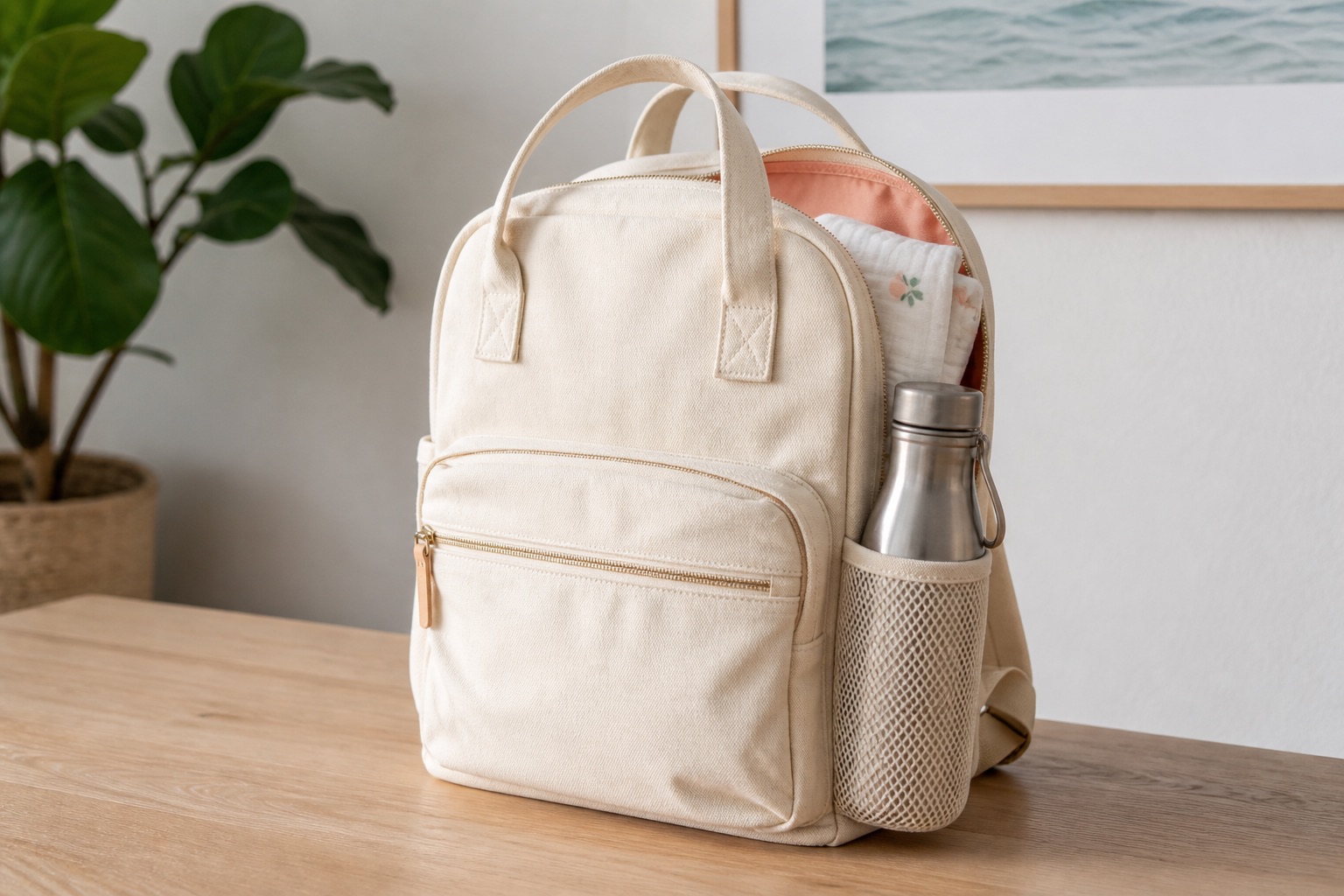
Orlando is not a climate you dress a baby for once and forget. A morning walk from a Lake Nona apartment, an afternoon on International Drive, a park day, and the I-4 ride back to a hotel all ask different things of the same small pile of gear. Heat sits on the pavement. Humidity soaks a cotton shirt. Cars are the default between neighborhoods. Indoor queues are long, cold, and crowded. The useful list is short: shade you can move, a way to carry the baby when a stroller is in the way, a child restraint that matches Florida’s published rules, and a sleep-and-change kit that works in a room that was never a nursery.
This is a gear note for families who live here and families who fly in for a park week. It is not a product review, not a catalog of brand names, and not medical advice. Florida Highway Safety and Motor Vehicles publishes the state’s child-restraint rules. National Weather Service Melbourne covers Central Florida heat and storms. Read those pages; do not treat this article as a substitute.
Shade that moves with you
Central Florida sun is a planning problem, not a souvenir. Visit Orlando’s weather page describes summers as hot and humid, with afternoon showers a regular part of the season, and it tells visitors to stay hydrated and to use early mornings and evenings when they can. A stroller canopy is the simplest moving roof you can buy. It covers the baby on a sidewalk, in a park, in a hotel porte-cochère, and in the long walk from a parking garage. A muslin cloth is the spare roof: it drapes, it wipes, it becomes a light cover in a cold indoor queue, and it dries faster than a heavy blanket after a storm. Neither one replaces sunscreen for the adults, and neither one is a promise that the park is cool.
On International Drive the shade is uneven. Storefronts and hotel canopies help in short bursts; the parking lots and crosswalks do not. Downtown sidewalks have trees in some blocks and open sky in others. Lake Nona and many apartment complexes are built around parking and a hot walk to the car. A canopy that actually stays over the seat, and a cloth you can wring out, matter more here than a decorative liner.
Do not drape a thick blanket over a stroller in this heat. The point of shade is a roof with air moving under it. A ventilated canopy plus a light muslin is the usual Orlando mix. If you use a clip-on fan, point it so it moves air across the baby rather than blasting a face, and keep cords out of reach. Check the day’s forecast on NWS Melbourne before you leave the room; a clear morning can still build clouds.
A carrier and a stroller do different jobs
A stroller earns its keep outdoors: park paths, apartment loops, the walk from a hotel room to a bus stop, a long midday stretch when the baby might nap under a canopy. It also carries water, diapers, and a spare shirt, which in Orlando is not optional cargo. A carrier earns its keep indoors and in tight motion: security lines, indoor queues, a bus-to-gate walk, a shop aisle, a hotel lobby, a moment when you need two hands and the stroller is parked.
Many families bring both and switch. The stroller lives at the edge of a queue. The carrier goes into the queue. That is a park-day pattern, not a rule about any one attraction. The compact-stroller versus carrier argument for a hot Orlando afternoon is the compare page. The afternoon bag is the park-day packing guide: compact stroller, mineral sunscreen, spare outfit, carrier, insulated bottle bag.
Each park writes its own stroller policy: size, where you leave it, whether wagons are allowed. Those rules change. Walt Disney World publishes a toddlers and young children guide and a stroller rentals page. Universal Orlando keeps visiting-with-kids notes under plan your visit. SeaWorld Orlando answers stroller rental on its FAQ and points guests to Guest Services at the entrance. Read the park you are walking into. Hours and gate rules live on each park's own pages.
For a household that lives here, the same split shows up on ordinary Tuesdays. A stroller is the tool for a shaded path and a grocery run. A carrier is the tool for a doctor’s office, an indoor playground, or a downtown block where the sidewalk narrows. If you only have room for one on a flight, decide from the week you actually booked: more outdoor park time favors a canopy stroller; more indoor days and hotel hallways favor a carrier you already know how to put on in a parking garage.
Florida child-restraint rules. Read FLHSMV, not a rumor
Florida does not leave child-restraint law as a hallway tip. The Florida Department of Highway Safety and Motor Vehicles publishes Safety Belts and Child Restraints. That is the page to read before you fly in, before you pick up a rental car at the airport, and before you drive a baby down I-4, through Lake Nona, or across downtown.
As that page currently states: Florida law requires seat belts or child restraint devices for drivers, all front-seat passengers, and all children under 18 riding in a vehicle. Children age 5 and under must be secured in a crash-tested, federally approved child restraint device. Children ages 0 to 3 must be in a separate carrier or a vehicle manufacturer's integrated child seat. Children ages 4 through 5 must be in a separate carrier, an integrated child seat, or a booster seat. FLHSMV also writes that the best seat is the one that fits the child's size, is correctly installed, fits the car, and is used every time you drive. Rear-facing is described there as the right start for a young child. Stay rear-facing until they reach the height or weight limit of that seat. In their words, "as long as possible, usually until age 2 or 3."
Those cuts live on FLHSMV’s page. They can be updated. Do not treat a blog, a family group, or this article as the law. Install from the seat manual and from the vehicle manual, which is also what FLHSMV tells you to do. Their page links fitting stations by county and NHTSA recall checks at nhtsa.gov/recalls. If you are using a rental car or a rideshare, you still need a restraint that meets the rule; a hotel shuttle and a theme-park bus are not a workaround.
A parked car in Orlando heat is its own hazard. The National Weather Service’s heat safety page is blunt: it is never safe to leave a child locked in a car, and young children are particularly vulnerable to heat. That applies in a theme-park lot, a Wawa run off International Drive, and an apartment parking garage in August.
What to bring to a hotel room that is not a nursery
A hotel room near the parks is a bed, a bathroom, air conditioning, and a window that often faces a parking lot or a bright corridor. It is not a full nursery. The useful kit is the kit that turns that room into a place a baby can sleep and a place you can change a diaper without unpacking a household.
Hotels commonly take a crib or play-yard request as a note on the reservation and fill it if they have one. That is ordinary practice at family-oriented Orlando properties. It is not a hold you can treat as certain. Ask when you book. Ask again the day before. Confirm at the hotel front desk when you check in, and look at the sleep space yourself before you leave for the parks. The U.S. Consumer Product Safety Commission's Safe Sleep page is the standard for what belongs in that space: a product intended for sleep (crib, bassinet, play yard, or bedside sleeper) that meets federal requirements, baby on the back, nothing but a fitted sheet. CPSC's line is "Bare is Best." If the hotel unit arrives with extras, extra bedding is not a gift. Take it out.
Bring a fitted sheet you already know, if you have one that matches the travel sleep space you actually use. Bring a changing pad that lies on a dresser or a bathroom counter, because a hotel bed is a terrible changing table. Bring a small monitor if the room layout puts the sleep space around a corner from where you will sit. Bring two spare shirts for the baby and one for you. Summer storms on this peninsula are short, wet, and indifferent to your dinner reservation. Bring the same shade cloth you used in the park. It is a nursing cover, a burp cloth, and a blackout helper on a bright window if the drapes leak. A travel blackout piece or extra clips help in rooms that face International Drive signage or a pool deck that stays lit after closing time.
Do not try to recreate a full nursery in a suitcase. Formula or milk storage, medicines, and feeding gear follow whatever your pediatrician already set for home. Those lists stay with your clinician. The rest of the job is bassinet versus play yard, humidity, air conditioning, and blackout. That lives in the bassinet guide.
A household list and a park-week list
Families who live in Orlando already own the heat. The household list is about a Florida apartment: a sleep space that still works when the air conditioner runs all night, blackout for a room that faces east, a stroller that handles a hot sidewalk, a restraint that is legal on every car in the driveway, and soft goods that survive the wash twice a week. Lake Nona, downtown, and the International Drive hotel strip are not the same walk, but they share humidity and cars.
A park week adds motion. You need the restraint for the airport-to-hotel drive and every paid parking garage after that. You need shade that moves. You need a carrier for indoor lines. You need a hotel sleep space that you inspected, not assumed. You need a spare outfit in the stroller basket because NWS Melbourne’s summer pattern is afternoon and evening storms, not a polite mist. Read the park-day guide for the shape of the day; the bag you carry into that day is the subject.
If you are writing us about a mix, start from these jobs, not from a pile of unused objects. A welcome for a first apartment. A shower table. A park-week kit. Baby Orlando is a baby-gear and gift company in this city. The catalog is organized as gear, nursery, and gift. Inquire at sales@tabaconda.com. Publisher: Baby Orlando and Tabaconda LLC.