
A park day with a baby in this city has a shape, even when the ticket, the nap, and the storm refuse to match the plan. Early light is cooler and the walks from the car are shorter in the sun. The middle of the day is heat and humidity. For much of the year it is also a building chance of lightning. The end of the day is a tired baby, a bright parking garage, and I-4. You do not need a minute-by-minute itinerary. You need a way to start, a way to get out of the sun, and a way to read the park you actually entered.
This is a day-shape note. It is not medical advice. It is not a ticket counter. Hours, stroller rules, and guest-services notes live on each park’s own pages; those pages change. Check National Weather Service Melbourne before you leave the room.
Early light
Orlando mornings in the warm months are already humid, but they are the part of the day when pavement has not stored the afternoon yet. Visit Orlando’s weather page tells visitors that summer highs often sit in the 90s with high humidity, and it points people toward early mornings and evenings. That matches how a baby day actually runs: feed, change, and get through the parking-to-gate walk before the canopy is doing all the work.
Park opening times are not a number this article will invent. Walt Disney World posts hours on its calendars. Universal Orlando posts hours under plan your visit. SeaWorld Orlando posts hours on its theme park hours page. Read the day you hold a ticket for. Rope-drop folklore is not a substitute for the park’s own listing.
The early window is also when a stroller is easiest to live with. Paths are less jammed. Indoor queues, when they exist at opening, are shorter. A carrier still matters at security and at the first indoor attraction. Gear to try for that split is the park-day baby-gear kit; when the compact stroller belongs versus the carrier is the compare page.
If you are staying on International Drive or near the parks, the drive itself is part of the heat: a car seat in a parked vehicle warms fast. Start the air conditioning, then load the baby. NWS heat safety is explicit that young children are particularly vulnerable and that a child should not be left in a car.
Indoor rest through the hot middle
East Central Florida has a named summer rhythm. NWS Melbourne’s climate note The Florida Rain Machine describes how Atlantic and Gulf sea breezes collide inland, producing widespread storms with frequent lightning and heavy rain. The office writes that people joke they can set a watch by the afternoon rain; it calls that an exaggeration, then explains the real pattern: humidity returns in late spring, and the rainy season is the stretch of hot, humid months with frequent showers and lightning. For Orlando, that page lists a median rainy-season start of May 27 and a median dry-season start of October 15. June through September are the wettest months in the telling most residents already know.
The same office’s daily forecasts, through the summer, commonly describe afternoon and evening storms, sea-breeze collisions, and heat-index values that feel hotter than the air temperature. Those are forecasts, not a clock you can print on a onesie. Do not build a “always rest from this hour to that hour” rule from a blog. Do build a habit: when the sky towers, when the heat sits on the stroller canopy, when the baby’s neck is damp and the line is outdoors, go indoors.
Indoors means a show, a dark attraction, a baby-care room, a table under a roof, a hotel room if you are close enough to make the round trip worth it, or a long feed in air conditioning. Walt Disney World describes Baby Care Centers on its preschool guide as quiet rooms, changing tables, a feeding area, and links a dedicated Baby Care Centers page. Universal's visiting-with-kids material and SeaWorld's Guest Services page are where those parks describe their own family rooms and stroller help. Lightning is not a cute Florida quirk. If storms are building, you want a roof, not a souvenir cart.
A midday hotel break is a real Orlando pattern for families staying on the International Drive strip or at a property near the gate they are using. It is not required, and traffic on I-4 can eat the break you thought you had. If the room is the rest plan, treat the return as part of the day: water in the car, shade in the garage, a sleep space that is already set up. The bassinet guide covers that room.
Hydration and shade
NWS heat-safety material names infants and young children as a group less able to adapt to heat than adults. Visit Orlando's weather FAQ adds the practical visitor version: stay hydrated, wear light clothing, and use mornings and evenings. For a baby, "hydrated" means whatever feeding plan you already follow. Breast milk, formula, or water only when your own clinician has said water is appropriate. This article will not invent ounces. Bring the feeding gear you actually use. Keep it out of a hot parked bag. Do not wait for a cry in an unshaded queue to notice the problem.
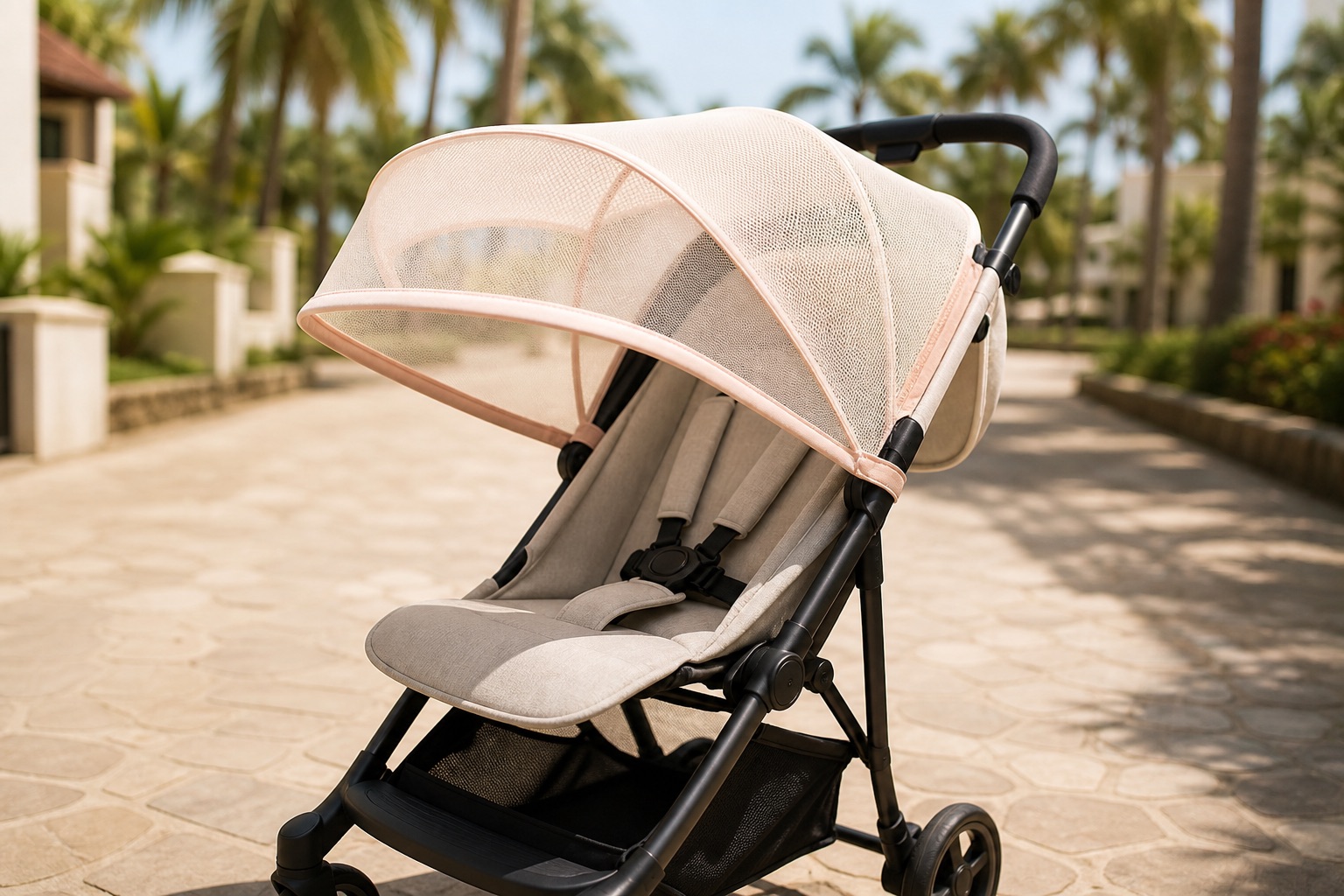
Shade is a canopy, a hat the baby will keep on, a muslin, a table under a roof, an indoor rest. It is not the park’s job to be cool. Outdoor queues in August are a heat load. A stroller with a ventilated canopy is the moving version of a roof; a carrier with a light cloth is the version that fits a line. After a storm, the air is still heavy and the pavement still throws heat. A spare shirt in the stroller basket is not fussiness. NWS Melbourne’s summer storms are often short and soaking. Visit Orlando notes that a sunny morning can turn into a rainy afternoon and then clear again, and that hurricane season on the calendar runs from June 1 to November 30. Orlando is inland; that does not make a summer afternoon dry.
Adults need water they will drink. Parks publish their own rules for what you may bring through the gate. Read those rules on the park’s page rather than copying a list from a stranger. Baby food and formula are commonly treated as an exception; confirm on the park you are entering. SeaWorld Orlando’s FAQ, for example, discusses baby food and formula at arrival with park security or guest relations. Disney and Universal write their own versions. Read the park you are walking into.
Stroller rules and hours live on each park’s page
Every major Orlando park writes its own visiting-with-kids material, and the only honest way to use it is to open it. Stroller size, stroller parking, whether you may bring a wagon, rental locations, baby-care rooms, and hours are the park’s to publish. They change. Hours and stroller size belong on the park you enter the week you travel.
For Walt Disney World, start with the toddlers and young children guide, then stroller rentals, Baby Care Centers, and the calendars for hours. Guest Relations is described on Disney’s Guest Relations page.
For Universal Orlando, start with tips for visiting with kids and the wider plan your visit section, including park hours. Universal’s own destination writing for families also lives on the official Discover Universal kids guide.
For SeaWorld Orlando, start with the FAQ (stroller rental near Guest Services, hours that “vary throughout the year,” baby food and formula notes) and the hours page. Guest Services is at the entrance; that is their description, not a street address for Baby Orlando.
Tickets, reservations, hours, and stroller rules live on each park’s own pages. If a page on this site and a park page disagree, the park page wins.
After the parks: I-4, the hotel, and bedtime
The day does not end at the gate. The walk to the car is often the hottest walk you took. The garage is a heat box. I-4 is slow when everyone else leaves too. A baby who napped under a canopy still needs a real sleep space in the room: dark enough, cool enough, flat, empty of pillows. Hotel drapes on International Drive often lose to signage and pool lights. Ask the hotel front desk about extra hanging space or a play yard if that was the plan; inspect it. The gear list for that room is in the baby-gear guide. The sleep-space question is in the bassinet guide.
Families who live here still use this shape on a resident annual-pass day. Downtown, Lake Nona, the neighborhoods off the interstate. The difference is that the "hotel" is your own apartment, and the blackout problem is your own east-facing window. The weather is the same peninsula.
Write sales@tabaconda.com if you want a gear or gift mix for a park week. Publisher: Baby Orlando and Tabaconda LLC.
Public pages this article relies on
- NWS Melbourne
- NWS Melbourne, The Florida Rain Machine
- NWS, Heat safety
- Visit Orlando weather
- Walt Disney World, toddlers and young children
- Walt Disney World, stroller rentals
- Walt Disney World, Baby Care Centers
- Walt Disney World calendars
- Universal Orlando, tips for visiting with kids
- Universal Orlando park hours
- SeaWorld Orlando FAQ
- SeaWorld Orlando hours